
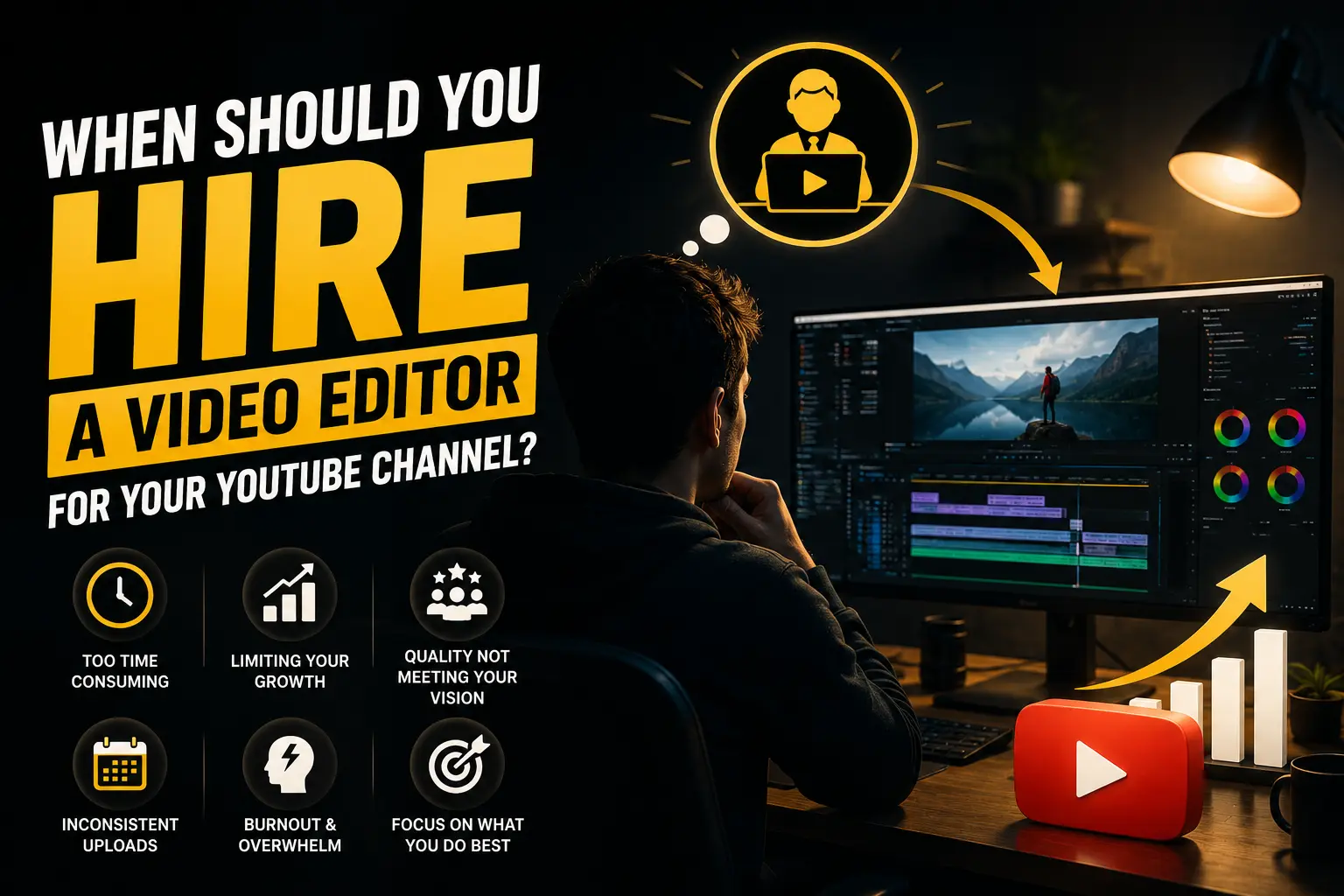
Editing your own videos is worth doing when you're starting out — it's how you actually learn what your pacing should feel like and what your audience sits through versus skips. But there's usually a point, a few months or a few years in, where the same skill that got you here starts holding the channel back.
You know it's happening when ideas start piling up faster than you can finish them. A video that took two hours to shoot eats three evenings in the timeline. Or you notice, watching a creator you admire, that your ideas have gotten better than your editing has — and the gap between them is starting to show.
There's no subscriber count that flips a switch here. It's really a question of workload against how much your own hours are worth right now. Below are the signs I'd actually pay attention to.
01 Editing Is Taking More Time Than Creating
This is probably the most obvious sign. You enjoy researching, writing, filming, or presenting. Then you open the editing software. Suddenly three days disappear. A single YouTube video can involve reviewing raw footage, removing mistakes, restructuring sections, finding B-roll, adding graphics, choosing music, cleaning audio, creating captions, color correction, exporting, and revisions.
For simple videos, that may not be a problem. But as your production quality increases, the editing workload usually increases with it. If you're spending significantly more time editing than researching, scripting, filming, or growing the channel, you should ask whether editing is still the best use of your time. Hiring an editor allows you to shift your attention back toward the parts of the channel that only you can do.
02 Editing Is Limiting How Often You Upload
Consistency matters on YouTube, but consistency becomes difficult when every upload requires several days of post-production. You may have scripts ready. You may have videos already recorded. But they sit on a hard drive waiting to be edited. That's not really a content problem — it's a production bottleneck.
Suppose you're capable of researching and recording one video every week, but editing each video takes another week. Your channel is now limited by editing capacity rather than ideas. A professional editor can remove that bottleneck. While they edit one video, you can begin researching or recording the next. Instead of working in a completely linear process — research, script, record, edit, upload, start again — you can begin working in parallel:
You: Research → Script → Record next video
Editor: Edit → Revise → Deliver previous video
That change alone can make a channel much easier to scale.
03 You Are Turning Down Opportunities Because You Are Too Busy Editing
Your YouTube channel may eventually create opportunities outside YouTube — sponsorships, client work, product development, consulting, business operations, collaborations, research, audience engagement. If editing consumes most of your available working hours, those opportunities become harder to pursue. At that point, the cost of editing your own videos is no longer just your time. It's the value of everything else you can't do during those hours.
This is where hiring decisions become less about:
"Can I afford an editor?"
and more about:
"Is my time now more valuable somewhere else?"
If the answer is yes, outsourcing editing may be financially sensible even before your channel becomes extremely large.
04 Your Videos Need Skills You Do Not Have
There's a point where improving the production value of your videos requires more than basic cuts — better pacing, professional sound design, animated maps, motion graphics, custom diagrams, visual storytelling, better B-roll selection, cleaner color correction, more polished transitions, stronger narrative structure.
You could learn all of these skills yourself. Given enough tutorials, caffeine, and mild resentment toward After Effects, almost anything is possible. But learning every production skill may not be the best use of your time. A specialized editor may already have years of experience solving the exact problems you're trying to learn from scratch. If your creative vision has become more ambitious than your editing ability, hiring someone can help close that gap.
05 Your Videos Feel Less Professional Than Your Content Deserves
Sometimes the problem isn't that editing is taking too long. The problem is that the final video doesn't feel as strong as the idea behind it. You may have a good script, strong research, useful information, good camera quality — but the finished video still feels slow, inconsistent, or visually weak.
Editing affects how information actually lands. A strong editor is constantly making small calls — when the viewer needs something to look at, when to cut, when to hold a shot a beat longer, where silence works better than another sound effect. None of that is about making the video look expensive. It's about the footage getting out of the way of the point you're making. If your editing is quietly working against your ideas, that's worth fixing before you assume the ideas are the problem.
06 You Are Spending Too Much Time Fixing Technical Problems
Editing is partly creative. It's also surprisingly good at inventing technical problems at the least convenient moment — audio synchronization, missing media, codec problems, export errors, color mismatches, frame-rate issues, slow playback, corrupted project files, graphics that refuse to behave for reasons known only to Adobe.
These problems are normal parts of post-production. But they can consume hours if editing isn't your primary profession. A professional editor deals with these problems regularly and usually has a workflow designed to avoid many of them before they happen. If technical troubleshooting is consuming time you'd rather spend creating content, that's another strong reason to outsource.
07 You Want to Publish More Without Sacrificing Quality
Scaling a YouTube channel creates a difficult problem. You want to produce more, but you don't want every video to become simpler just because your upload frequency increased. This is where an editor can become part of your production system rather than simply someone who finishes individual videos.
Suppose you want to move from 2 videos per month to 1 video every week without reducing research quality or visual polish. If you continue doing everything yourself, something usually has to give — research becomes rushed, editing becomes simpler, uploads become inconsistent, or you work considerably longer hours. A good editor allows production capacity to increase without forcing the creator to personally absorb every additional hour of work.
08 You Have Developed a Clear Style
Interestingly, one of the best times to hire an editor is after you already understand what you like. If you've edited your own videos for a while, you probably know how fast your videos should feel, how your captions should look, how much B-roll you prefer, which creators inspire your visual style, what kinds of transitions you dislike, how you use music, and how heavily you want to use motion graphics.
That makes delegation much easier. You're not asking an editor to invent your entire identity — you're giving them a direction they can learn and refine. Over time, the editor becomes familiar with your preferences. Eventually, you may not need to explain every decision. This is one of the biggest benefits of working with the same editor consistently.
09 You Are Repeating the Same Editing Decisions Every Week
If every project involves the same process, that work may be ready to delegate. Perhaps every video needs the same intro style, similar captions, similar B-roll treatment, the same lower thirds, consistent music, similar color treatment, and the same export settings.
Once a process becomes predictable, it becomes easier to hand off. You can create brand guidelines, reference videos, folder structures, editing notes, and reusable assets. Then your editor handles the repeated production work while you focus on the parts that change from video to video. Delegation is much easier when you're not reinventing the workflow every week.
10 You Are Starting to Treat YouTube Like a Business
There's a major difference between uploading videos as a hobby and running a channel as a serious content operation. A business doesn't normally ask one person to do every task forever. As the channel grows, different parts of production may eventually involve researchers, writers, thumbnail designers, editors, producers, and channel managers.
Editing is often one of the first major tasks creators outsource because it consumes a large amount of time and can be clearly separated from filming. If YouTube is becoming part of your business, your personal brand, or your marketing strategy, building a reliable production workflow becomes more important than doing everything personally.
When Should You NOT Hire a Video Editor Yet?
Hiring an editor isn't automatically the right decision. There are situations where continuing to edit your own videos makes more sense.
You Are Still Learning What Kind of Content You Want to Make
If your channel changes style every week, it may be difficult for an editor to establish a consistent direction. Experimenting yourself can be valuable early on.
You Do Not Have a Sustainable Budget
Professional editing is an ongoing production cost. If paying an editor for a few videos would create financial pressure, waiting may be smarter — you want a workflow you can maintain, not one that disappears after three uploads.
You Enjoy Editing and Have Enough Time
There's nothing inherently wrong with editing your own videos. Some creators genuinely enjoy the process and want complete creative control. If editing doesn't prevent you from publishing or doing other important work, there may be no reason to outsource it.
Your Videos Require Very Little Editing
Not every channel needs complex post-production. If your content only requires basic cuts and cleanup, outsourcing may provide limited benefit. The goal isn't to hire people simply because a channel has grown — the goal is to remove actual bottlenecks.
Should You Hire an Editor Full-Time or Work With a Freelancer?
Once you decide to outsource editing, the next question is usually how. For many creators, hiring a full-time editor immediately is unnecessary. A freelance video editor can provide professional editing without requiring a full-time salary or permanent position.
This works particularly well when you publish a few videos each month, have variable production volume, need specialized skills, want to test a working relationship first, or prefer project-based or monthly pricing. As the channel grows into a larger content operation, an in-house editor or agency may eventually make sense. But for many growing YouTube channels, a long-term freelance editor provides a useful middle ground between doing everything yourself and building an internal production team.
How Much Should You Prepare Before Hiring an Editor?
The better your preparation, the easier the relationship will be. Before contacting an editor, try to have:
A Clear Content Style
Provide examples of your existing videos or channels whose editing you like.
A Defined Publishing Schedule
Let the editor know whether you need one video per month, one per week, or something else.
An Approximate Video Length
Editing a 5-minute talking-head video is very different from editing a 20-minute documentary.
An Idea of the Editing Complexity
Explain whether the project requires basic cuts, B-roll, captions, motion graphics, maps, visual research, or sound design.
A Realistic Budget
Professional video editing should be treated as part of your production budget rather than an unexpected expense after recording.
A Feedback Process
Decide who will review the video and how revision notes will be delivered. Clear feedback is one of the easiest ways to make an editing relationship efficient.
What Should You Look for in a YouTube Video Editor?
Don't choose an editor based only on price. Look for someone whose work fits the kind of content you're creating. Pay attention to relevant portfolio work, storytelling, pacing, visual taste, communication, reliability, motion graphics ability, sound design, and understanding of YouTube content.
A technically skilled editor can still be the wrong creative fit. If you make educational documentaries, an editor who specializes entirely in hyperactive short-form content may not understand the pacing you want. The right editor should understand what the video is trying to achieve, not merely what buttons to press.
The Simple Test: Is Editing Still the Best Use of Your Time?
If you're unsure whether you're ready to hire an editor, ask yourself one question:
If someone else handled the editing, what would I do with those hours?
If your answer is "probably nothing important," keep editing yourself. But if your answer is any of the following:
- I could research another video.
- I could record more content.
- I could work with sponsors.
- I could focus on my business.
- I could actually maintain a consistent upload schedule.
then you already know the answer, you're just waiting for permission to act on it. There's no subscriber threshold for this — the moment is whenever editing turns from "part of the process" into the thing standing between you and the next video.