
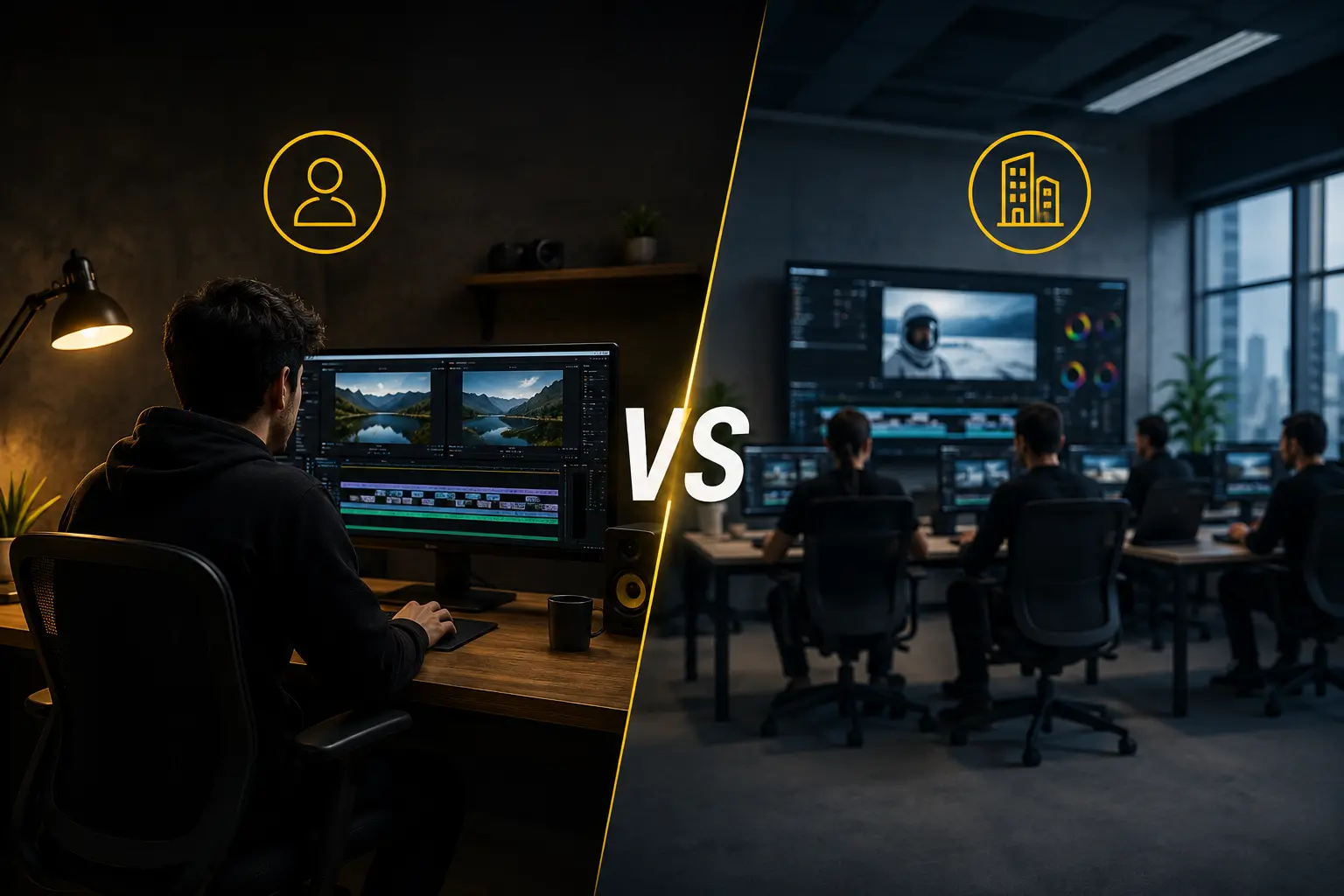
Every few months a client asks me some version of the same question: "Should I just go to an agency instead?" Usually they're not unhappy with the work — they're worried they've outgrown a single freelancer, or they got a cold outreach email from an agency promising more capacity. It's a fair question, and the honest answer isn't "freelancers are always better." It depends on what's actually slowing your channel down.
I edit as a freelancer, so take that as context, not a disclaimer that invalidates anything below. Both models can produce excellent work. What changes is the shape of the relationship — who you talk to, how fast things move, and how much the person editing your video actually knows about it by the tenth project.
What You're Actually Hiring When You Hire a Freelancer
A freelance video editor is one person, working directly with you, usually handling more of the process than just cutting clips together. Depending on the editor, that can stretch across story and pacing, B-roll selection, motion graphics, map animation, sound design, color correction, captions, visual research, music, and the revision rounds themselves.
The part that actually matters isn't the skill list — it's that your notes land directly on the person making the creative calls. No account manager rephrasing your feedback, no coordinator deciding what's worth passing along. You say it once, to the person doing it.
What You're Actually Hiring When You Hire an Agency
An agency manages a roster of editors and often bundles in extras — project management, motion design, thumbnails, social cuts, sometimes content strategy. You're not hiring a person anymore, you're hiring a system. Depending on the agency, that system might include an account manager, a project manager, one or more editors, motion and sound specialists, and someone doing quality control before anything ships to you.
That's genuinely useful once volume gets high enough — a business needing dozens of videos a month across several platforms can lean on a bigger team in a way one person can't match. What you give up is directness. Every layer between you and the timeline is a place your intent can get slightly reinterpreted.
01 Communication
This is the one where freelancers usually win, and it's not close. You explain what you want, the editor asks a clarifying question or two, you give feedback, they make the change — with nobody standing between your idea and the timeline where it actually gets executed.
It matters most on the feedback that isn't really about technique. Something like:
"This section feels too fast. I want the viewer to sit with the idea for another few seconds before we introduce the map."
That's not an instruction, it's a mood you're describing. An editor who's been on the project from the start can usually translate that correctly. Route the same note through a project manager first, and there's a real chance it arrives as "make it slower" — technically true, creatively flattened.
02 Speed
More editors on staff sounds like it should mean faster turnaround, and sometimes it does — mostly when volume is high enough that one person genuinely can't keep up. But a bigger team also means more handoffs, and handoffs are where time quietly disappears: approvals, briefings, someone catching someone else up on context they weren't in the room for.
A freelancer's workflow is usually just client, editor, delivery. When a revision is needed, it goes back to the same person who built the edit — no re-briefing required, because they never forgot what the project was about in the first place.
03 Flexibility
Video projects don't stay inside their original plan. A 10-minute video becomes 13. The script changes after the footage is already shot. A client needs a second version by tomorrow. None of that is unusual — it's just what production actually looks like.
Independent editors can bend around that without checking it against an internal policy first. Agencies, by design, run on more standardized workflows and packages — which is exactly what lets them manage many clients at once, but it's also what makes an unusual, mid-project curveball harder to absorb gracefully.
04 Creative Consistency
If you publish regularly, your audience starts noticing patterns whether you planned them or not — how your videos open, how fast scenes cut, what your captions look like, when the edit goes quiet on purpose. That accumulation is your visual identity, and it's built one video at a time.
Stay with the same freelance editor long enough and you stop having to explain most of it. They already know you'd rather under-animate than over-animate, which stock footage would look wrong on your channel, where a scene needs to breathe. That familiarity is what actually cuts down revision rounds — not stricter briefs, just shared context.
An agency can hold onto that too, but only if the same editor stays on your account. Some do this deliberately. Others rotate projects based on who's free that week, and the visual language drifts a little every time someone new picks it up.
05 Cost
Price alone doesn't tell you much here — a seasoned freelancer can easily cost more than a budget agency, and a premium agency can cost far more than almost any individual editor. The number that matters more is what's built into it.
Agencies carry real overhead: project managers, account managers, office costs, sales staff, software licenses across a whole team, quality control on top of the edit itself. That overhead is priced into what you pay, even on projects that don't need any of it. A freelancer's pricing is simpler because there's less structure to fund — mostly you're paying for one person's time and judgment.
None of that makes the cheapest option automatically the smart one. An edit that comes back for the fifth round of revisions wasn't actually cheap, whatever the invoice said.
Best value for most individual creators and small teams: Freelancer
06 Specialized Skills
Some projects need more than a standard edit — a documentary might need archival research and map animation, a product video might need screen recordings and motion graphics. Both freelancers and agencies can cover this. The label on the invoice doesn't tell you who actually can.
The only real check is the portfolio. If your project leans heavily on animated maps, look for real map-animation work, not a generic reel. Someone great at fast-cut social content isn't automatically the right fit for a slow documentary, freelancer or agency either way.
07 Scalability
This is where agencies genuinely pull ahead. Twenty long-form videos, sixty short clips, multiple aspect ratios, several language versions, every month — that's a production line, not a single person's calendar. One freelancer runs out of hours long before an agency runs out of editors.
A good freelancer can absolutely handle steady, recurring work. But everyone eventually hits a ceiling on how much one set of hands can move through in a month, and no amount of enthusiasm changes that math.
Best for very large-scale production: Agency
08 Accountability
An agency gives you a backup plan — if one editor is out, someone else can usually step in. With a freelancer, you're depending on one person, and if they disappear mid-project, there's no bench behind them.
The upside of that same setup is that there's zero ambiguity about who's responsible for the work. The person you're emailing is the person who cut the timeline. A freelancer who treats the relationship as ongoing rather than transactional tends to protect that reputation carefully, because it's the only thing bringing in the next project. Before hiring either, the actual due diligence is the same: check the portfolio, ask for a reference, confirm the revision policy and turnaround before money changes hands.
Freelancer vs Agency: Quick Comparison
| Factor | Freelance Editor | Editing Agency |
|---|---|---|
| Direct communication | Excellent | Varies |
| Flexibility | High | Moderate |
| Creative consistency | Excellent with long-term editor | Depends on team |
| Cost efficiency | Usually high | Usually higher overhead |
| High-volume scalability | Limited | Excellent |
| Specialized expertise | Depends on freelancer | Can access multiple specialists |
| Revision speed | Often fast | Depends on workflow |
| Personal creative relationship | Strong | Usually less direct |
| Backup capacity | Limited | Strong |
| Best for custom projects | Excellent | Good |
| Best for massive content pipelines | Limited | Excellent |
When Should You Hire a Freelance Video Editor?
A freelance editor is probably the better choice if:
- You want to communicate directly with your editor.
- Your videos require creative storytelling rather than assembly-line editing.
- You want one person to understand your style over time.
- You publish YouTube videos, documentaries, talking-head content, or branded videos.
- Your project needs flexibility.
- You want professional editing without paying for an entire agency structure.
- You prefer building a long-term relationship with one editor.
Freelancers can be particularly effective for creators and companies publishing a manageable number of high-quality videos each month. In those situations, knowing the channel deeply can be more valuable than having a large production team.
When Should You Hire a Video Editing Agency?
An agency may be the better option if:
- You need a very large volume of content.
- Several videos must be edited simultaneously.
- You need multiple creative services under one contract.
- Your company requires formal account management.
- You need guaranteed production redundancy.
- Your content operation has already grown beyond what one editor can realistically handle.
For large organizations, the additional structure of an agency may justify the higher overhead.
So, Which Should You Hire?
If your bottleneck is genuinely volume — you need twenty assets shipped every month across formats — an agency's structure earns its overhead. That's not a close call.
Most of the creators and small teams I talk to aren't actually in that position, though. Their bottleneck is usually something closer to "I need someone who gets it without a three-paragraph brief every time." That's a relationship problem, and a freelancer solves it better than a system built to manage many clients at once.
The part worth remembering either way: a good editor stops being "someone who cuts footage" once they've worked on enough of your videos to understand why a scene should slow down before you say so. That happens through repetition with one person, not through the org chart you hired them under.